
Would Intermittent Fasting Work for Me? Why This Lifestyle Shift is Worth the Try
This is a question many people are asking today. Would intermittent fasting work for me??
Maybe you have heard friends talk about intermittent fasting.
Maybe you have seen dramatic before-and-after stories online.
Or perhaps you are simply tired of constantly feeling hungry, sluggish, frustrated with weight gain, or trapped in unhealthy eating patterns.
If you’ve been curious about intermittent fasting (IF) but haven't taken the plunge—or if you tried it and felt totally overwhelmed—this post is for you.
You may still wonder:
“Would intermittent fasting actually work for me?”
The truth is — there is only one real way to know.
You try it.
Not perfectly.
Not aggressively.
Not as another extreme diet.
But as a simple lifestyle adjustment that allows your body the opportunity to function differently.
And honestly… what do you really have to lose by trying?
Intermittent fasting does not require expensive supplements, costly programs, special shakes,
or complicated meal plans. For many people, it simply begins by creating a longer break
between meals and becoming more intentional about eating patterns and nutritionally
balanced meals.
That’s all.
And sometimes the simplest changes create the most powerful results.


The Immense Benefits:
What Does Research Says
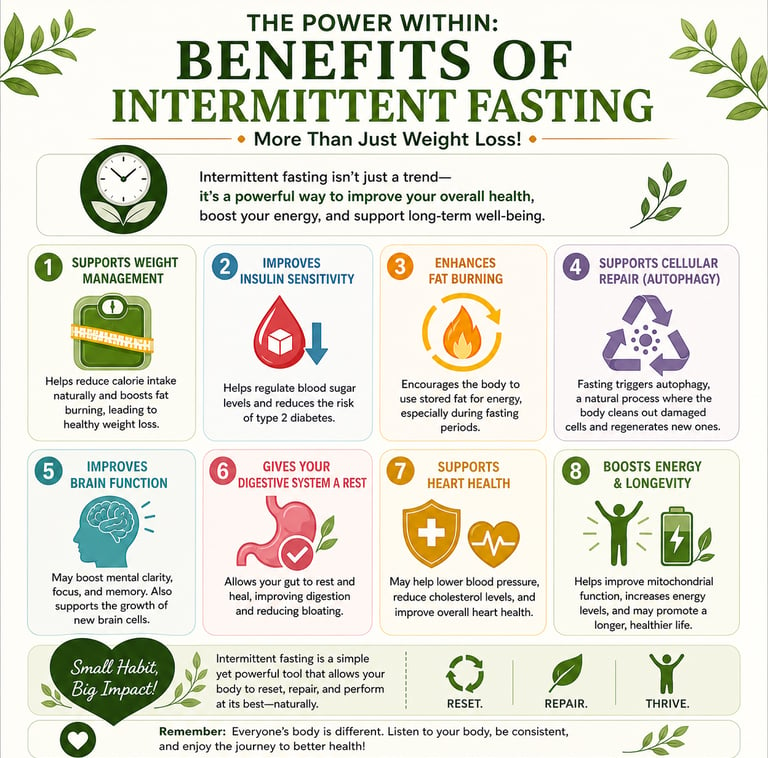
Research on intermittent fasting has grown significantly over the last decade, with studies suggesting potential benefits such as:
Improved insulin sensitivity
Better blood sugar regulation
Support for weight management
Reduced inflammation
Improved metabolic health
Better awareness of hunger and eating habits
Potential improvements in energy and focus
A review published in The New England Journal of Medicine highlighted that intermittent fasting may trigger metabolic switching, allowing the body to transition from using glucose to utilizing stored fat and ketones more effectively.
Heart Health: Research shows that short-term fasting can significantly improve blood pressure, resting heart rate, and cholesterol levels.
Brain Power: Fasting increases the production of Brain-Derived Neurotrophic Factor (BDNF), a protein that supports the survival of neurons and enhances learning and memory.
Reversing Diabetes: Clinical trials have documented that IF can be a powerful tool for managing and even reversing type 2 diabetes by reducing insulin resistance.
So… Would Intermittent Fasting Work For You?
Maybe.
Maybe not perfectly overnight.
Maybe not dramatically in one week.
But your body would respond positively to:
fewer blood sugar spikes
less mindless eating
more intentional meal timing
giving digestion a break
creating healthier routines
And perhaps the bigger question is:
What if this simple lifestyle shift could help you feel healthier, more energized, and more in control of your eating habits?
You are not signing your life away.
You are not risking anything extreme.
You are simply giving your body the opportunity to function differently.
And that opportunity alone may be worth exploring.
Small, intentional changes often lead to powerful long-term results.
Give Yourself Grace During the Transition
If you are worried about feeling "hangry" or tired, know that there is a transition period. It typically takes two to four weeks for your body and brain to adapt to the metabolic switch. During this time, it is normal to feel a bit irritable or have a headache, but these are temporary signs that your body is learning to become metabolically flexible again.
The Bottom Line:
Don’t be too hard on yourself. Start slow, find a window that works for your social life, and focus on the long-term gains. When you stop viewing it as a "diet" and start seeing it as a way to let your body heal itself, you’ll begin to see the immense benefits in your own life.
⚠️ Important Note
Intermittent fasting is not suitable for everyone. Individuals who are pregnant, breastfeeding, underweight, have a history of eating disorders, diabetes, or medical conditions should consult a doctor or qualified healthcare professional before beginning intermittent fasting.
Research references:
de Cabo R, Mattson MP. Effects of Intermittent Fasting on Health, Aging, and Disease. New England Journal of Medicine (2019)
Patterson RE, Sears DD. Metabolic Effects of Intermittent Fasting. Annual Review of Nutrition (2017)
Anton SD et al. Flipping the Metabolic Switch. Obesity (2018)
Mattson, M. P., de Cabo, R., & Longo, V. D. (2019). Effects of intermittent fasting on health, aging, and disease. The New England Journal of Medicine, 382(18), 1773-1784.
Is intermittent fasting right for me? - Mayo Clinic Press, https://mcpress.mayoclinic.org/nutrition-fitness/is-intermittent-fasting-right-for-me/
The Health-Promoting Effects and the Mechanism of Intermittent ..., https://pmc.ncbi.nlm.nih.gov/articles/PMC10005873/
Intermittent Fasting: What Is It, And How Does It Work? | Johns Hopkins Medicine, https://www.hopkinsmedicine.org/health/expert-qa/intermittent-fasting-what-is-it-and-how-does-it-work
Intermittent Fasting and Its Effects on the Brain | Alzheimer's Disease Research Center, https://adrc.wisc.edu/dementia-matters/intermittent-fasting-and-its-effects-brain
Fasting diet: Can it improve my heart health? - Mayo Clinic, https://www.mayoclinic.org/diseases-conditions/heart-disease/expert-answers/fasting-diet/faq-20058334
Maybe The Problem Is Not Only What We Eat
Modern lifestyles have normalized constant eating.
Breakfast.
Snacks.
Coffee with sugar.
Lunch.
Afternoon cravings.
Evening snacks
Dinner
Late-night eating.
Many people rarely allow their bodies a break.
Over time, constant eating may contribute to:
Energy crashes
Cravings
Poor blood sugar control
Weight gain
Fatigue
Unhealthy eating habits
Intermittent fasting introduces something many bodies have not experienced in years:
REST
When you give your body a break from constant digestion, you unlock several powerful physiological "switches" that research has proven to be transformative:
During fasting periods, insulin levels begin to decrease, allowing the body to gradually shift from constantly storing energy to accessing stored energy more efficiently. In simple terms, the body becomes better at using stored fat for fuel.
This is one reason intermittent fasting has gained so much attention in both the health and scientific world.
But What If I Tried Before And Failed?
This is important.
Many people try intermittent fasting once, feel overwhelmed, and give up quickly.
Why?
Because they approach it like another strict diet challenge.
They suddenly skip meals aggressively.
Push themselves too hard.
Become overly restrictive.
Feel miserable.
Then conclude: “Intermittent fasting is not for me.”
But maybe the issue was never intermittent fasting itself.
Maybe the problem was the mindset.
Intermittent fasting works best when viewed as a gradual lifestyle adjustment ----and not as a punishment.
You do not need to jump immediately into long fasting windows.
Sometimes simply:
Reducing late-night eating
Avoiding constant snacking
Allowing 12 hours between dinner and breakfast
Becoming more mindful about hunger
can already make a meaningful difference.
This approach feels sustainable because it adapts to your life instead of forcing your life to revolve around a diet. And sustainability matters.
Because the healthiest lifestyle is not the one you follow perfectly for two weeks.
It is the one you can realistically maintain long term.


Intermittent Fasting Is Not About Perfection
You do not need to do it perfectly to benefit from it.
Some days will go smoothly.
Other days will not.
That is normal.
The goal is not an obsession.
The goal is progress.
And perhaps one of the most powerful benefits of intermittent fasting is that it encourages people to reconnect with true hunger, intentional eating, and healthier habits.
It creates awareness.
“Am I eating because I am hungry?”
“Or because I am bored, stressed, emotional, or simply used to snacking?”
Sometimes those small moments of awareness can completely change a person’s relationship with food.